No one talked about “self-care” when I was young. On the contrary; there were ritualistic ways in which the Catholic Church inculcated the opposite: shame, guilt, and self-flagellation. Perhaps especially in the stoic German self-negating form of Catholicism that I inherited.
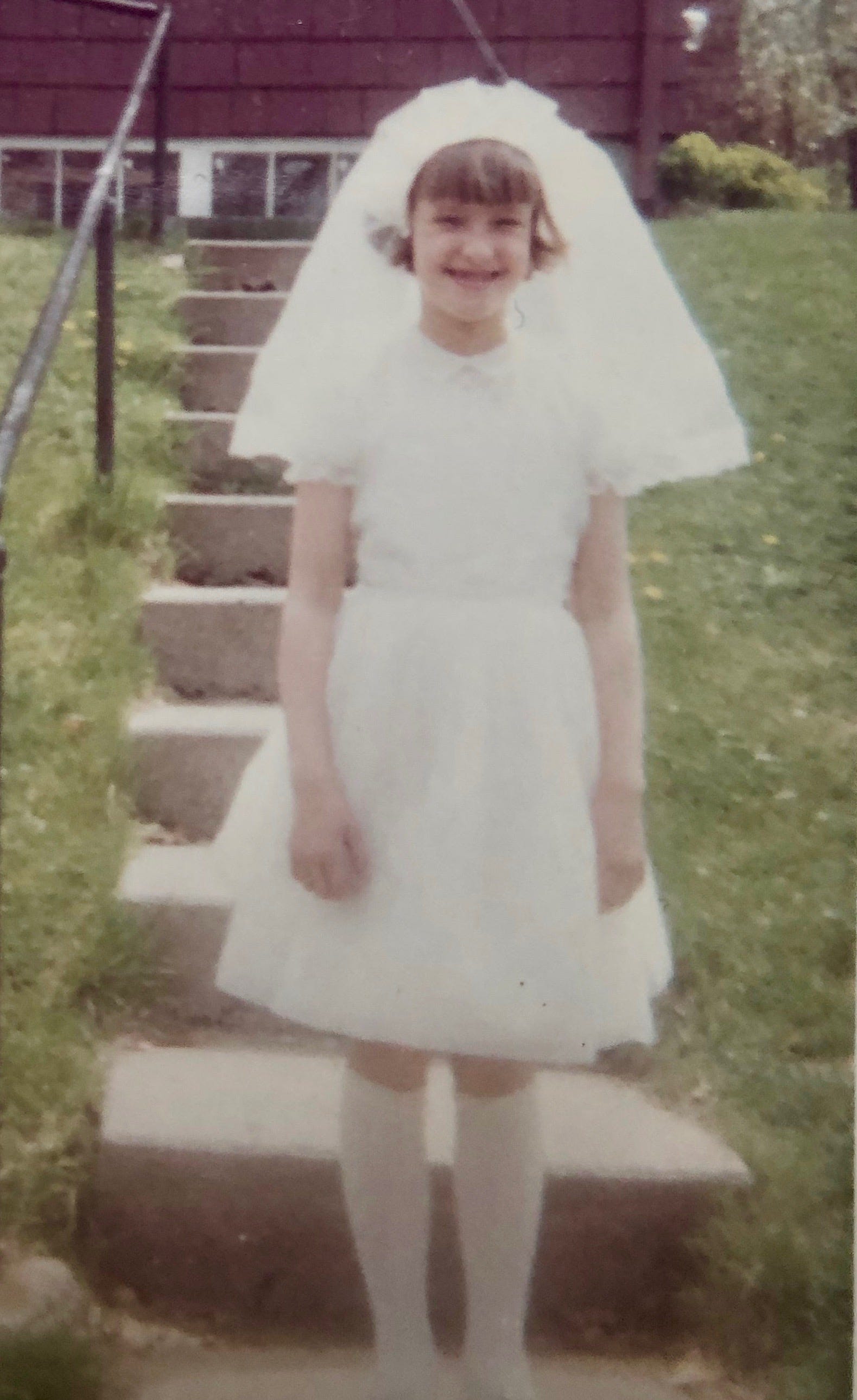
Photo caption: First Communion, Spring 1967
There were times when Catholic rituals made me feel special. Like my first communion in 1967. My mother sewed me a simple white dress and a headband with a gauze veil. We piled into the family station wagon and headed down Main Street to St. Mary’s. I lined up with my age-mates outside the church - girls in white dresses on one side, boys in dark suits and miniature blue ties on the other. I wore white knee-high nylon socks. (I think they were tucked into the sensible red leather tie shoes my mother bought us each year, though the photo I study to re-conjure this day cuts my feet off at the ankles, so I’m not sure. But in my mind’s eye at least, the rest of the girls wear shiny, new, black patent dress shoes.)
There was a fresh smell of lilacs in the air. We walked in procession through the heavy oak doors, past a set of flickering candles set in red cups and a stone bowl of “holy water” that was guarded by a cold white marble saint, through another set of heavy oak doors to the inner sanctum, and down the red carpeted aisle to kneel on hard wooden benches facing the altar.
Spring sunshine punched through the stain glass windows, illuminating somber faces that stared down at us with bored looks of martyrdom in an otherwise dark interior. Heavy incense perfumed the air. I felt so small under the huge domed ceiling painted with more sad-eyed virgins cloaked in long robes. And frightened, especially when I had to approach the purple-robed priest at the altar, kneel at his feet, stick out my tongue, and receive “the body of Christ.” I didn’t understand what I was eating, and I didn’t like the cardboard taste.
First Communion was accompanied by induction into a ritualistic way of self-flagellation: a weekly process of taking stock of every possible transgression and confessing “sins” to a priest. Perhaps it was the Catholic Church, more than my parents, that instilled the incessantly self-critical inner voice that would accompany me through my life.
One day not long after my First Communion, when I was seven or eight years old, I found myself inside the confessional in the dark basement of St. Mary’s church. My mother waited outside, kneeling on a church bench, waiting her turn. My five older siblings were likely waiting their turns as well, though once again they seem erased from my memory banks. My little sisters must have stayed at home, probably with my grandmother.
The hard wood pressed into my bones as I knelt on a splintery bench behind a thick velvet curtain and listened to the solemn voice of the man in the adjacent box, his profile framed behind the sliding window in the confessional, his face turned away from me.
Now it was my turn: “Oh my God I am heartily sorry for having offended Thee. It has been two weeks since my last confession. These are my sins.”
I had carefully prepared my script. I needed to be properly “bad.”
“I was jealous of my sisters.” “I didn’t help out enough at home.”
I began to stumble. “I told three lies.” Was it three or two? Was I lying about lying?
Sin. Sin. Sin.
Oh my God.
Oh. My. God.
My? God?
My god.
I’m sorry. I’m sorry. I’m sorry.
I have sinned, I am a sinner, I am bad, bad, bad.
I felt my bladder trembling. I clenched my thighs as tightly as I can, but it was too late. A sweet sickly smell permeated that punishing wooden box as I felt the sticky fluid rushing down my legs.
What did the man behind the window do? Did he hear, smell, see?
What would I say to him now?
I am heartily sorry for having offended Thee.
No, not that.
How did I offend Thee and my God, Thy God?
Who is this Thou that You can be so offended by Me?
What are these practices that scare a little girl into peeing in her pants, thinking she is bad, worrying she was not bad enough or too bad or that she doesn’t know what counts as properly redeemably bad, what dark spots on her soul marks can be erased with the power of a patriarchal voice meting out my penance, counting Hail Marys and Our Fathers as if reciting empty words means anything to a child who doesn’t understand just what it was that she did wrong.
Oh my God I am heartily sorry.
My sorry heart.
When I left the confessional, I had a new confession to make, this time to my mother. I don’t remember what she said or did, only my sense of her mortification, and my shame.
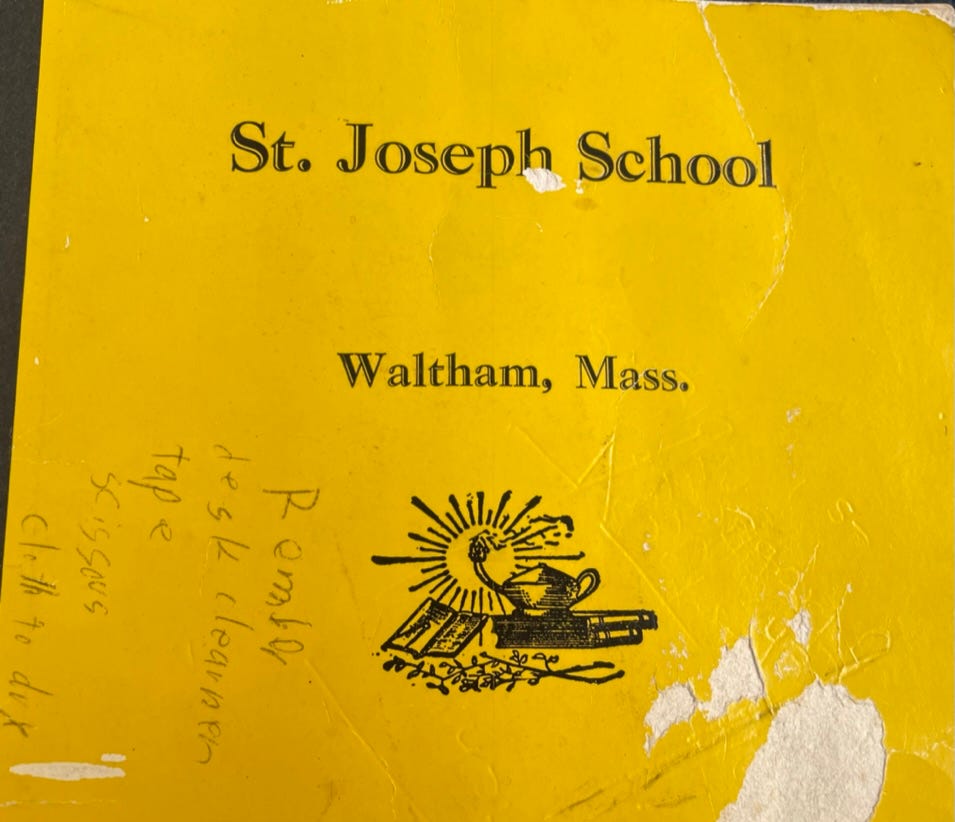
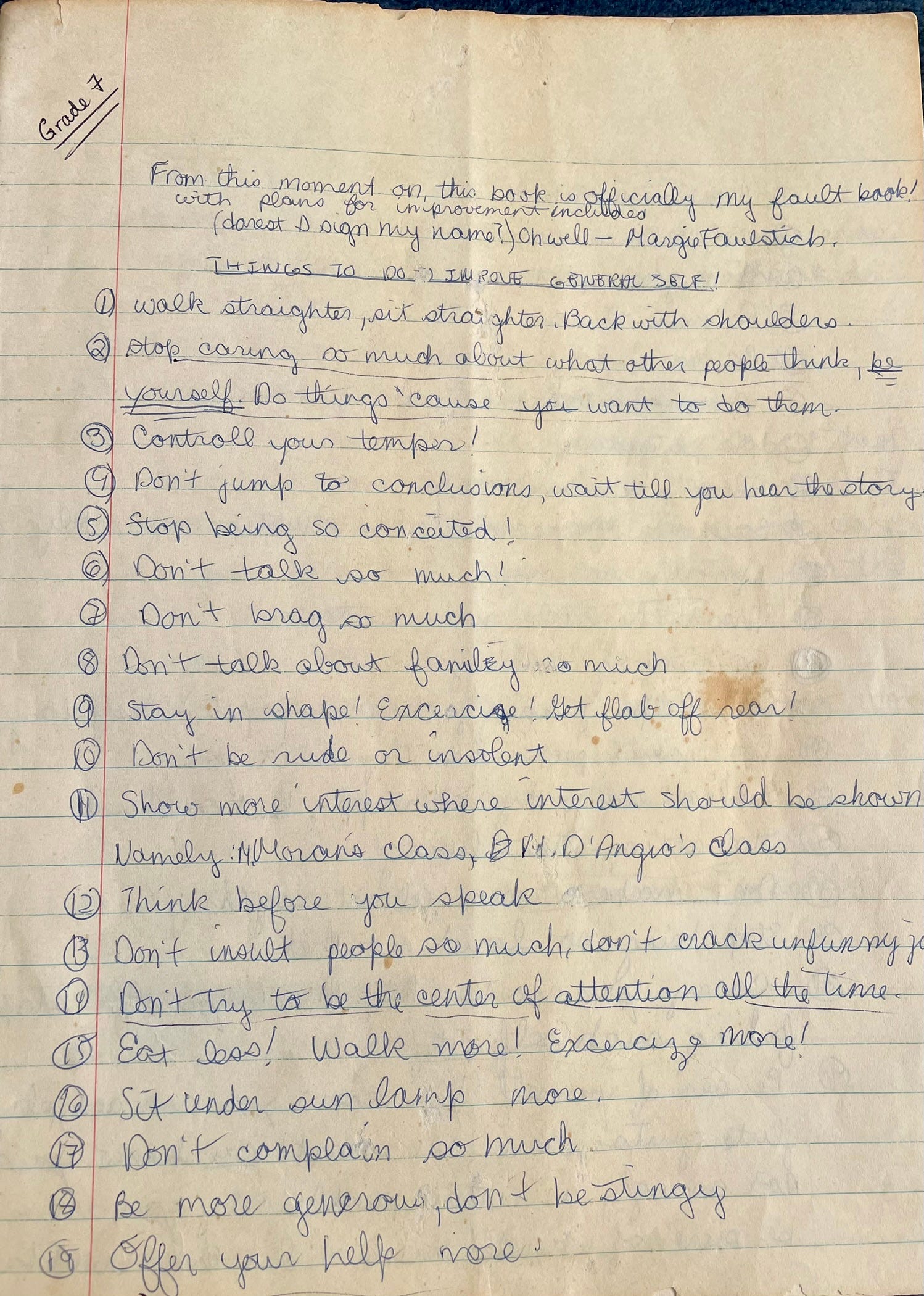
In seventh grade I had a plain yellow notebook, embossed with the name of my elementary school’s patron saint. On the first page I wrote, in an adolescent’s rounded script, “This book is officially my fault book.” Then a title: “My Sins Against God and Man.”
“I don’t pay enough attention to my little sisters.”
“I am rude and insolent.”
“I am too fat.”
The list is long. 100 proofs that I am not worthy. A litany of admonitions for self-improvement.
I complained.
Told three lies.
Lied about lying.
Didn’t just take what I was given.
Wanted more.
More, more, MORE!
I kept someone waiting.
I was too fat.
Took up too much space.
(Fat is a sin? An offense against Men?)
Didn’t stay silent and small.
Peed in the confessional.
And lied.
Many years later, my good friend Ericka, who is Jewish, would tell me: “The difference between Catholic guilt and Jewish guilt is that Jewish guilt is interpersonal. You Catholics do it to yourselves.” She suggested,“Why don’t you take one item on that list each day and do it to the max?”
Be rude and insolent all day. Reclaim my sins. Proclaim my selfishness to the world.
But really, healing does not come from pushing our pain outward. That just makes the cycle continue. The father hits the mother who yells at the child who kicks the dog.
Healing is a much longer, slower, protracted process. For me, it took going deeper into my own shadow, and slowly, slowly, slowly, getting back in touch with the little girl who peed in that confessional. Looking at all that shaped her. Seeing how the list of admonitions I wrote back then repeats itself. Until it doesn’t.
It took inspiration from others who have done their own work, and guidance from those who could hold their own stuff enough to help me carry – and release – my own.
May we each do our own work and create more possibilities for those who follow - so we can truly “go in peace” to love and serve.
My friend Ericka wrote to me privately: “To clarify, I don't think catholics do it to themselves (which would be blaming you) I think it is incredibly unfair because it pits you against God. What kind of odds are those? Especially for a seven year old girl?”
Thank you for sharing your insights . Recognizing some of the good parts in each of the groups we belong to is a key, but also understanding how they shape possibilities that we may or may not accept and need to take a new pathway. You are sharing pathways with us and how they shaped those the language you’re learning in the life choices and that is such a privilege for me to learn from and with you about.
Any Group we belong to or taken to will shape possible ways of knowing being and doing in worlds and as individuals within this complex social world we need to be able to step back and contrast what we believe or want or the pathway we anticipate taking and what others are telling us to do or no or understand. Then we can make decisions about how to be in worlds and what to avoid or change or share to make transparent how to engage with these challenges.
I thank you again because reading your words makes me and Love ways you share life experiences to consider my own journeys and commitments. Once again you opened halfway and four grounded pathways that i and others might want to consider in our own worlds.
Rarely have I seen or read a history of someone, I value so clearly to see intersections and alternatives and ways of making transfer it the pathways and decisions central to understanding and sharing the impact of lived experiences across our lives. Thank you again.


My friend Ericka wrote to me privately: “To clarify, I don't think catholics do it to themselves (which would be blaming you) I think it is incredibly unfair because it pits you against God. What kind of odds are those? Especially for a seven year old girl?”
Thank you for sharing your insights . Recognizing some of the good parts in each of the groups we belong to is a key, but also understanding how they shape possibilities that we may or may not accept and need to take a new pathway. You are sharing pathways with us and how they shaped those the language you’re learning in the life choices and that is such a privilege for me to learn from and with you about.
Any Group we belong to or taken to will shape possible ways of knowing being and doing in worlds and as individuals within this complex social world we need to be able to step back and contrast what we believe or want or the pathway we anticipate taking and what others are telling us to do or no or understand. Then we can make decisions about how to be in worlds and what to avoid or change or share to make transparent how to engage with these challenges.
I thank you again because reading your words makes me and Love ways you share life experiences to consider my own journeys and commitments. Once again you opened halfway and four grounded pathways that i and others might want to consider in our own worlds.
Rarely have I seen or read a history of someone, I value so clearly to see intersections and alternatives and ways of making transfer it the pathways and decisions central to understanding and sharing the impact of lived experiences across our lives. Thank you again.