


History may not repeat itself exactly, but there’s a whole lot we might learn from knowing history better than most people do.
Last week Jonathan Caravello, a philosophy lecturer in the math department at Cal State Channel Islands, was protesting an ICE raid at a farm in Camarillo, California. He was picked up, along with some 100 people, put into an unmarked vehicle, and taken to an unknown location. It does not appear that he was read his rights or given a reason for his detention.
This was a disappearance. Professor Caravello was disappeared.
I first learned that the word “disappeared” could be used in this way – as in something that is done to others – during the 1980s, when I worked in the Central American Solidarity Movement. My focus was on Guatemala, as my former husband was an unofficial refugee who had escaped its civil war. His father was a rice farmer who had lost his United Fruit Company job after a U.S.-led, CIA-backed invasion restored that company to its pre-unionized status and ended the only ten years of democracy that Guatemala had ever known. (The head of the CIA and the head of United Fruit Company were brothers.) His uncles had been tortured and killed, their burned bodies left at the side of the road. He had seen students – friends – shot in front of him during a protest in Guatemala City. He was 16 at the time and today would be considered an “unaccompanied minor” when he headed to the U.S. on foot.
More than 50,000 people were “disappeared” during the 1980s in Guatemala. 200,000 more were killed, including in scorched earth tactics as whole Mayan villages were burned to the ground to eliminate support for the guerrilla movement. While a “peace treaty” was signed in 1996, the war reverberates today in new generations of refugees fleeing the legacy of violence and the unresolved social issues that are at the heart of the current U.S. immigration crisis.
Our work in the Solidarity Movement was to raise awareness about human rights violations, and the role of the U.S. government in funding them. We hand-wrote signs with the names of the known disappeared and marched through the streets of Los Angeles. We organized a tribunal at LA’s City Hall, and brought trade unionists, teachers, and indigenous leaders to give their testimonials. Rigoberta Menchú, who went on to win a Nobel Peace Prize, told of how her father was burned alive along with 36 other people when they occupied the Spanish Embassy to protest the ongoing genocide. During her visit to LA, Rigoberta slept on our couch.
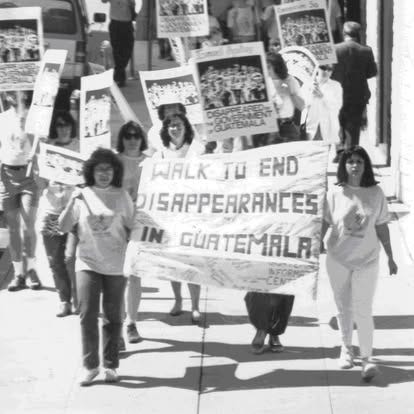
In the Solidarity Movement, I became friends with three siblings who had been students in Guatemala in the late 1970s. One day, they were picked up at school, put into an unmarked van, and whisked away. No one knew where they were. They had been disappeared.
A week or two later, they were released. But soon after that, more people started disappearing, never to be seen again. My friends think that they were an early test case to see how disappearing people would work as a counter-insurgency tactic. They have a case against the Guatemalan government right now; just as with so many war crimes, it may take years for these injustices to be recognized. By that time, the world has moved on. These things become history, forgotten by most people, and thought to be left in the past.
But the past is “never dead. It’s not even past,” as William Faulkner wrote in Requiem for a Nun. It continues to haunt us, as unhealed individual and collective traumas repeat themselves, and get passed on.
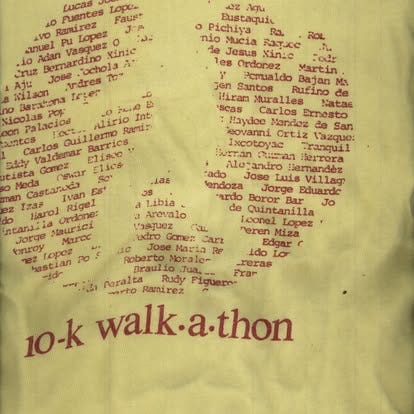
Can we learn from history, so we don’t find ourselves making T-shirts like this one, with too many names of those lost?
President Trump is detaining people without due process, for expressing their right to protest. He has deported U.S. citizens (for now, presumably, by mistake) and threatening to deport more. He wants to take Rosie O’Donnell’s citizenship away. He is detaining people in places that are, effectively, concentration camps. (Note that in Germany these were not initially death camps - genocide came later.)
“First They Came”, the prose-poem by the German Lutheran minister Martin Niemöller, is seeing a huge revival in the current moment. History likely will not repeat itself exactly, but it’s sure looking ominously familiar. In Germany, as the Nazis rose to power, and neighbors started to disappear, many ordinary Germans looked the other way. (As a German-American, this haunted my childhood.)
What will happen this time, if we don’t just look away?
Things you can do:
(1) Learn about history. Heather Cox Richardson’s daily posts and youtube videos are a great resource; she is educating us all about things we never learned in school and helping us respond to the current moment.
(2) Join a “Rapid Response” group to respond to disappearances and ICE attacks in your community. (We formed Rapid Response groups in the 1980s, and I’d like to think we saved a few lives.)
(3) Call your congresspeople. Call and call and call again.
(4) Share this essay and start a conversation with friends and family.
So timely and thoughtful as always. History unfortunately repeats itself in all its ugliness, yet it is always people defying all odds who make it change its course for the better. Linking hearts and arms with others who CARE about humanity, and you will find them in different political persuasions, good and truth will prevail. Adelante!
Refreshing moral clarity ❤️